












宇宙搭載衛星
X線とγ線は、波長が1 nm以下の高エネルギー光子からなる電磁スペクトルの一部です。天体から放射されるX線およびγ線を研究する分野は、それぞれX線天文学およびγ線天文学と呼ばれます。
X線放射は、温度が数百万ケルビン (K)から数億ケルビン (MK)に達する超高温ガスを含む天体から発生すると考えられています。相対論的粒子 (電子や陽子)が低エネルギー光子や物質と相互作用する際にも、X線およびγ線が生成されます。
超新星のような極端な現象や、パルサーやブレーザーに見られる極限環境下での物質の挙動は、電子・陽電子対消滅、逆コンプトン効果、さらには放射性物質の崩壊 (γ崩壊)によって明らかになります。また、LHCのような実験室の加速器をはるかに上回るエネルギーを持つ、自然界の「宇宙粒子加速器」からもγ線が放射されます。
このように、X線およびγ線天文学は、これらの現象をより深く理解するための重要な手段となっています。しかし、宇宙から到来するX線やγ線の多くは地球大気によって吸収されてしまいます。そのため、宇宙線 X線やγ線を直接検出するには、観測装置を気球や人工衛星によって大気圏外に配置する必要があります。衛星搭載のγ線観測装置では、一般的に電子・陽電子対生成を利用します。γ光子が検出器に入射すると電磁カスケードが始まり、その経路がトラッカーによって検出されます。これによって一次γ光子の到来方向を再構成することが可能です。
同時に、カロリメータによってそのエネルギーが測定されます。これらの衛星を用いることで、入射するX線の強度や到来方向の画像を再構成することもできます。衛星に搭載されたX線専用望遠鏡では、複数の放物面鏡によってX線が全反射され、焦点位置に設置されたカメラに集光されます。
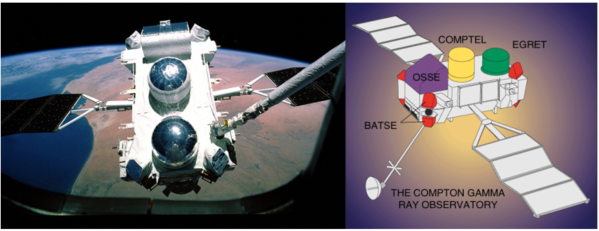
図1 左:CGRO衛星の外観。右:搭載機器の構成図。本観測衛星にはγ線観測のための4つの装置が搭載されていた。
γ線天文学は、1990年代に大きな進展を遂げました。これは、CGRO衛星に搭載された EGRET観測装置による観測のおかげです。CGROは、100 MeVを超えるエネルギーをもつ271のγ線源を発見することに成功しました。
CGRO (Compton Gamma Ray Observatory)は、高エネルギー宇宙を観測するための衛星型天文台でした。1991年4月5日、スペースシャトル・アトランティス (STS-37)から打ち上げられ、2000年6月4日の軌道離脱まで運用されました。当時としては極めて大型の天文観測機で、総重量は1万7000 kgに達し、γ線天文学の歴史に大きな足跡を残しました (図1参照)。
- BATSE (Burst And Transient Source Experiment): 20〜600 keVのγ線バーストを探索する装置でした。衛星の4隅に配置された8つのモジュールから構成され、各モジュールは大きなNaI検出器と、それを読み出す PMT (光電子増倍管)で構成されていました。
- OSSE (Oriented Scintillation Spectrometer Experiment): 0.05〜10 MeVのγ線を観測する4つのモジュールで構成されていました。各モジュールはNaIシンチレーターと、それを読み出す7本のPMTを備えていました。
- COMPTEL (Imaging Compton Telescope): 0.75〜30 MeVの光子を観測し、入射光子の到来角度を決定する装置でした。2つのシンチレーター・モジュールで構成され、γ線源の画像化を目的として設計されました。
- EGRET (Energetic Gamma Ray Experiment Telescope): 20 MeV〜30 GeVの高エネルギーγ線源の位置を測定する装置でした。検出器内部で生成される高エネルギー電子・陽電子の飛跡を測定し、2つの粒子が形成する「V字」軌跡の軸を空に向かって投影することで、一次光子の方向を再構成しました。最終的に、これらの粒子が持つ全エネルギーは装置後部に設置された大規模なカロリメータ型シンチレーター検出器で測定されました。
近年の重要なγ線観測装置としては、2008年に打ち上げられたFermi衛星 が挙げられます。GLAST (Gamma Large Area Space Telescope)として開発され、後にFermiと名付けられたこの衛星は、超大質量ブラックホールやパルサーの研究を可能にするとともに、新しい物理の探索にも貢献しています。
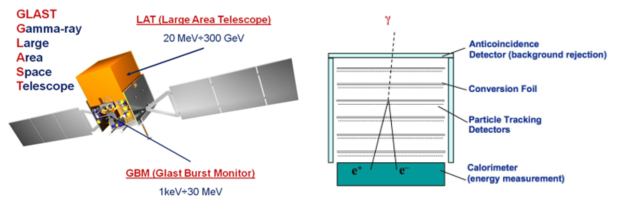
図2 左:Fermi望遠鏡の模式図。右:LAT (Large Area Telescope)装置の模式図。
Fermi望遠鏡には、GBMとLATの2つの観測装置が搭載されています。
Gamma-ray Burst Monitor (GBM) は、8 keV〜40 MeVのエネルギー範囲に感度を持ち、PMTで読み出される2種類のシンチレーターで構成されています。年間最大200件のガンマ線バーストを検出することを目的として設計されました。
Large Area Telescope (LAT) はFermi望遠鏡の主観測装置であり、EGRETの後継となる撮像型望遠鏡です。感度はEGRETの約2倍に向上しています。LATは薄いタングステン箔 (γ線コンバーター)とシリコン・ストリップ検出器 (SSD)を組み合わせた構造をもちます (図2)。タングステンコンバーターは4×4個のSSDアレイ2層の間に挿入されており、18枚のタングステンコンバーター層と16層の二重シリコントラッカープレーンが16のモジュール「タワー」として積層され、合計約9000枚のSSDが使用されています。
γ線がLATに入射すると、タングステン箔の原子と相互作用し、電子と陽電子の2つの荷電粒子が生成されます。その後、電子と陽電子は検出器内を進み、薄いシリコン・ストリップ検出器内でイオン化を引き起こします。この電荷シグナルが読み出し電子回路によって測定されます。シリコンストリップはX方向とY方向に交互に配置されており、検出器内部を通過する粒子の軌跡を追跡することが可能です。
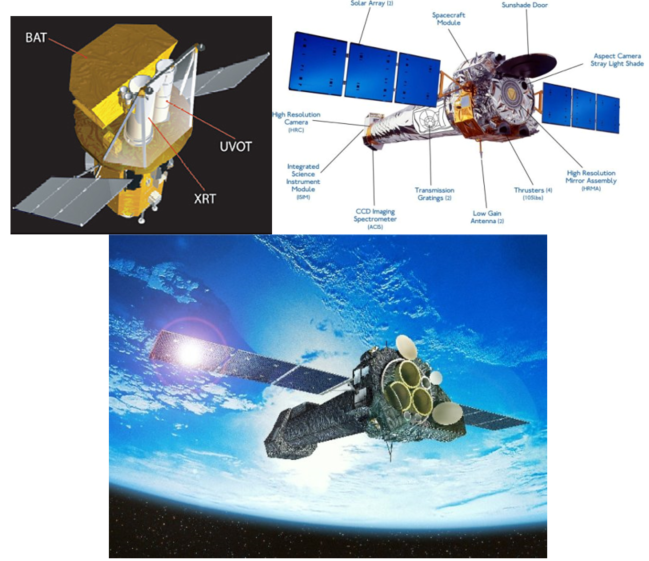
図3 上段:NASAのSWIFT 衛星 (左)とCHANDRA衛星 (右)。
下段:欧州宇宙機関 (ESA)のXMM-NEWTON衛星。
最初のX線天文学専用衛星はUhuruであり、1979年に初のX線源マップを提供しました。
X線天文学の発展により、パルサーの特性が明らかになったほか、既知の高密度天体 (白色矮星、中性子星、超新星、ブラックホールなど)や、その残骸、さらには強い磁場によって粒子を加速する活動銀河の研究が可能になりました。
現在軌道上で運用されている主な衛星には、XMM-NEWTON, CHANDRA, SWIFT (図3参照)があります。これらの衛星は、高解像度のX線源画像を取得するために設計されています。
これらの衛星を用いることで、入射する信号の強度や到来方向の画像を再構成することが可能になります。衛星に搭載された望遠鏡では、一連の放物面鏡によってX線が全反射し、その光がカメラへと集光されます。
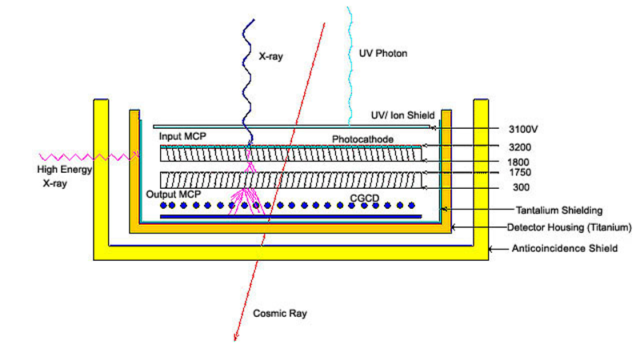
図4 Chandraに搭載されたHRC (High-Resolution Camera)の模式図。
Chandra X線観測衛星では、複数の鏡と4つの観測装置を組み合わせることで、天体から到来する X線を捉え、詳細な解析を行います。入射した X線は鏡によって高精度に一点へ集光され、その焦点位置には High-Resolution Camera (HRC)を含む2つの観測装置のいずれかが配置されます。
HRC (図4)の主要構成要素は、2枚のマイクロチャネルプレート (MCP)です。これらのMCPからの電子信号は、互いに直交するワイヤグリッドによって読み出され、元のX線が入射した位置を高い精度で特定することが可能になります。
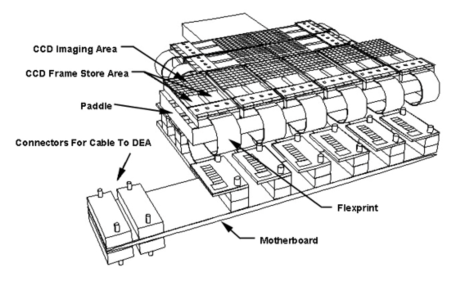
図5 ACIS (Advanced CCD Imaging Spectrometer)検出器の模式図。
これらの情報をもとに、天文学者は宇宙の X線源の詳細な構造を精密に描き出すことができます。
HRCは特に、爆発した恒星の残骸に含まれる高温物質、遠方の銀河や銀河団の観測、そして非常に弱いX線源の識別において有用です。
Chandraに搭載されたもう1つの焦点面観測装置がAdvanced CCD Imaging Spectrometer (ACIS)です。その名称が示すとおり、この装置はCCDアレイで構成されています (図5参照)。
この装置が特に有用なのは、X線画像を取得すると同時に、入射する各X線のエネルギーを測定できる点にあります。これにより科学者は、特定の化学元素が放出したX線だけを用いて天体の画像を作成することが可能になり、例えば超新星残骸の姿を、酸素イオンによるX線とネオンあるいは鉄イオンによるX線で比較することができます。また、ACISは、銀河間空間に存在する巨大な高温ガス雲のようなX線源の温度分布の研究や、超新星爆発によって残されたガス雲における化学組成の分布を調べる際に最適な観測装置です。
- Confirmation
-
It looks like you're in the . If this is not your location, please select the correct region or country below.
You're headed to Hamamatsu Photonics website for JP (Japanese). If you want to view an other country's site, the optimized information will be provided by selecting options below.
In order to use this website comfortably, we use cookies. For cookie details please see our cookie policy.
- Cookie Policy
-
This website or its third-party tools use cookies, which are necessary to its functioning and required to achieve the purposes illustrated in this cookie policy. By closing the cookie warning banner, scrolling the page, clicking a link or continuing to browse otherwise, you agree to the use of cookies.
Hamamatsu uses cookies in order to enhance your experience on our website and ensure that our website functions.
You can visit this page at any time to learn more about cookies, get the most up to date information on how we use cookies and manage your cookie settings. We will not use cookies for any purpose other than the ones stated, but please note that we reserve the right to update our cookies.
1. What are cookies?
For modern websites to work according to visitor’s expectations, they need to collect certain basic information about visitors. To do this, a site will create small text files which are placed on visitor’s devices (computer or mobile) - these files are known as cookies when you access a website. Cookies are used in order to make websites function and work efficiently. Cookies are uniquely assigned to each visitor and can only be read by a web server in the domain that issued the cookie to the visitor. Cookies cannot be used to run programs or deliver viruses to a visitor’s device.
Cookies do various jobs which make the visitor’s experience of the internet much smoother and more interactive. For instance, cookies are used to remember the visitor’s preferences on sites they visit often, to remember language preference and to help navigate between pages more efficiently. Much, though not all, of the data collected is anonymous, though some of it is designed to detect browsing patterns and approximate geographical location to improve the visitor experience.
Certain type of cookies may require the data subject’s consent before storing them on the computer.
2. What are the different types of cookies?
This website uses two types of cookies:
- First party cookies. For our website, the first party cookies are controlled and maintained by Hamamatsu. No other parties have access to these cookies.
- Third party cookies. These cookies are implemented by organizations outside Hamamatsu. We do not have access to the data in these cookies, but we use these cookies to improve the overall website experience.
3. How do we use cookies?
This website uses cookies for following purposes:
- Certain cookies are necessary for our website to function. These are strictly necessary cookies and are required to enable website access, support navigation or provide relevant content. These cookies direct you to the correct region or country, and support security and ecommerce. Strictly necessary cookies also enforce your privacy preferences. Without these strictly necessary cookies, much of our website will not function.
- Analytics cookies are used to track website usage. This data enables us to improve our website usability, performance and website administration. In our analytics cookies, we do not store any personal identifying information.
- Functionality cookies. These are used to recognize you when you return to our website. This enables us to personalize our content for you, greet you by name and remember your preferences (for example, your choice of language or region).
- These cookies record your visit to our website, the pages you have visited and the links you have followed. We will use this information to make our website and the advertising displayed on it more relevant to your interests. We may also share this information with third parties for this purpose.
Cookies help us help you. Through the use of cookies, we learn what is important to our visitors and we develop and enhance website content and functionality to support your experience. Much of our website can be accessed if cookies are disabled, however certain website functions may not work. And, we believe your current and future visits will be enhanced if cookies are enabled.
4. Which cookies do we use?
There are two ways to manage cookie preferences.
- You can set your cookie preferences on your device or in your browser.
- You can set your cookie preferences at the website level.
If you don’t want to receive cookies, you can modify your browser so that it notifies you when cookies are sent to it or you can refuse cookies altogether. You can also delete cookies that have already been set.
If you wish to restrict or block web browser cookies which are set on your device then you can do this through your browser settings; the Help function within your browser should tell you how. Alternatively, you may wish to visit www.aboutcookies.org, which contains comprehensive information on how to do this on a wide variety of desktop browsers.
5. What are Internet tags and how do we use them with cookies?
Occasionally, we may use internet tags (also known as action tags, single-pixel GIFs, clear GIFs, invisible GIFs and 1-by-1 GIFs) at this site and may deploy these tags/cookies through a third-party advertising partner or a web analytical service partner which may be located and store the respective information (including your IP-address) in a foreign country. These tags/cookies are placed on both online advertisements that bring users to this site and on different pages of this site. We use this technology to measure the visitors' responses to our sites and the effectiveness of our advertising campaigns (including how many times a page is opened and which information is consulted) as well as to evaluate your use of this website. The third-party partner or the web analytical service partner may be able to collect data about visitors to our and other sites because of these internet tags/cookies, may compose reports regarding the website’s activity for us and may provide further services which are related to the use of the website and the internet. They may provide such information to other parties if there is a legal requirement that they do so, or if they hire the other parties to process information on their behalf.
If you would like more information about web tags and cookies associated with on-line advertising or to opt-out of third-party collection of this information, please visit the Network Advertising Initiative website http://www.networkadvertising.org.
6. Analytics and Advertisement Cookies
We use third-party cookies (such as Google Analytics) to track visitors on our website, to get reports about how visitors use the website and to inform, optimize and serve ads based on someone's past visits to our website.
You may opt-out of Google Analytics cookies by the websites provided by Google:
https://tools.google.com/dlpage/gaoptout?hl=en
As provided in this Privacy Policy (Article 5), you can learn more about opt-out cookies by the website provided by Network Advertising Initiative:
http://www.networkadvertising.org
We inform you that in such case you will not be able to wholly use all functions of our website.
Close