




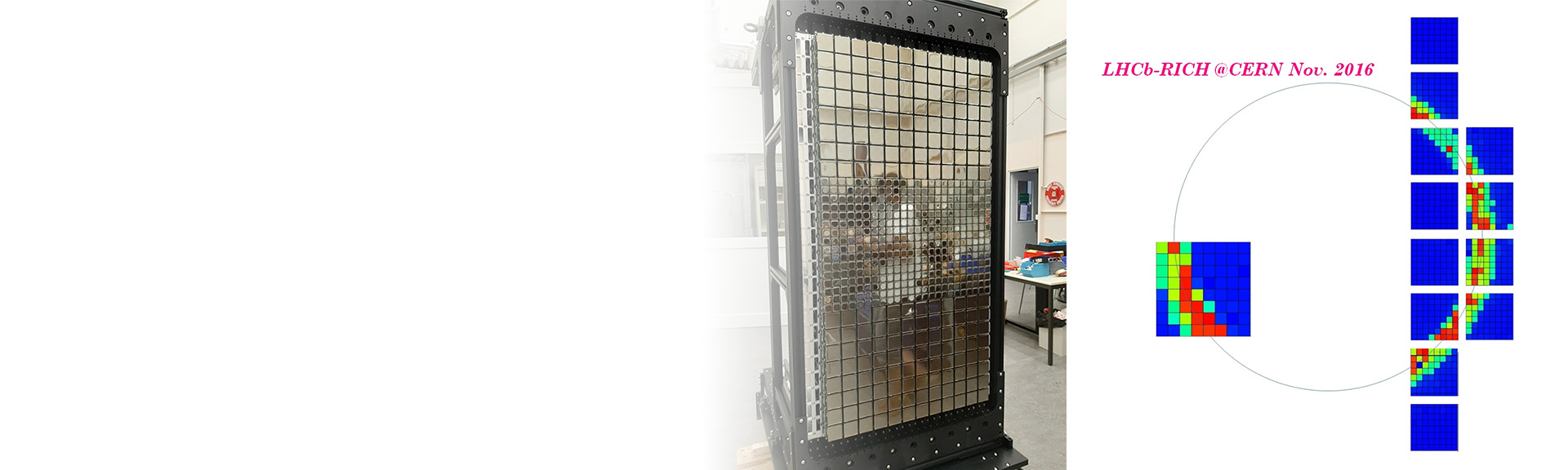
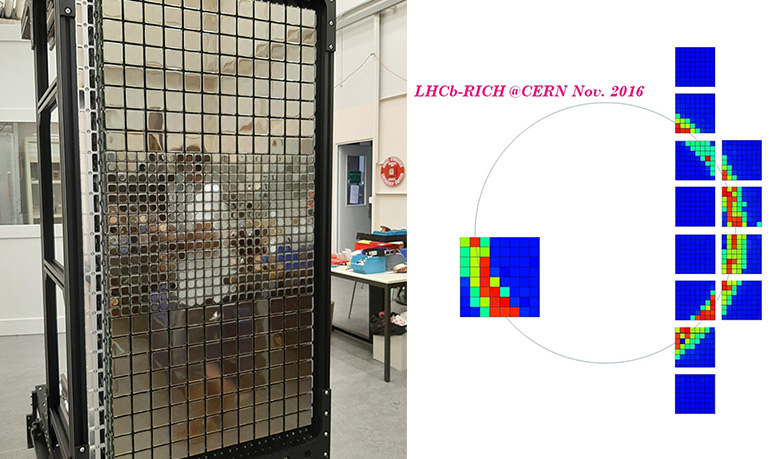
RICH検出器
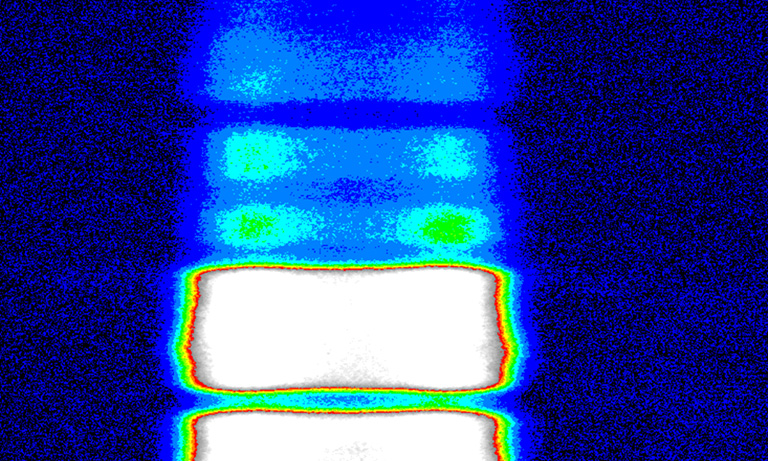
Ring Imaging Cherenkov (RICH)検出器は、粒子が放出するチェレンコフ光を利用して粒子種を識別するために設計された感光型位置検出器です。これらは加速器実験 (LHCb、ALICE、FAIR/CBMなど)で広く使用されており、ラジエーター (放射体)と、フォトセンサーを行列状に配置した感光面から構成されています。粒子がラジエーターを非常に高速で通過すると、光の円錐 (チェレンコフ光コーン)が形成されます。
感光面は、ラジエーターを通過した粒子が放出するチェレンコフ光を捕捉するように設計されています。RICH検出器は、このチェレンコフ円錐の放射角θを測定することで粒子の速度を求めることができます。さらに、トラッカーの情報と照合することで粒子の進行方向が得られるため、粒子の質量と電荷を計算できます。質量と電荷が分かれば粒子種を識別することが可能です。
この検出技術は、1977年にJack Séguinot氏とTom Ypsilantis氏によって初めて提案されました。原理は「媒質中では光速を超える速度で粒子が移動することができる」という現象に基づいています (媒質としては空気・水・氷・石英などが利用される)。粒子が媒質内を光より速く移動すると、光の“衝撃波”が発生します。この現象はチェレンコフ効果と呼ばれ、飛行機が音速を超えたときに発生するソニックブームによく似ています。
チェレンコフ光の放出は、粒子がラジエーターを通過する間、連続的に起こります。時間的に連続するいくつかの瞬間を考えると、光の放出位置が連なって最終的に円錐形を形成し、その放射角θは粒子速度に強く依存していることが理解できます。
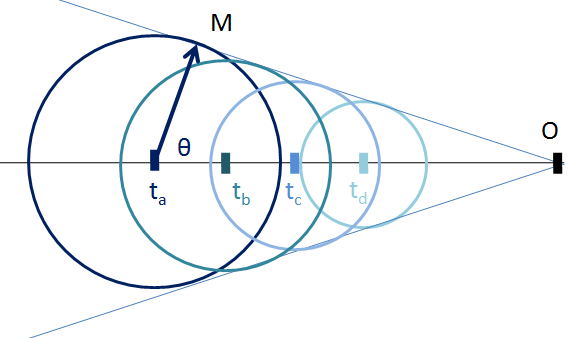
図1 粒子によるチェレンコフ光放出の模式図
粒子識別 (particle tagging)は、高エネルギー物理実験において最も難易度の高い課題のひとつです。現代の粒子加速器では、極めて高いイベント発生率とバックグラウンド条件が検出器の性能に厳しい制約を与えています。最終状態において荷電ハドロンを識別することを目的とする高エネルギー物理実験では、RICH型検出器の使用が不可欠となっています。
NA62はCERNに設置されたカイオン生成実験で、非常に稀なカイオン崩壊、K⁺ → π⁺ + ν + ν̄、を測定することで、CKM行列要素 |Vtd| の10%精度での測定を目指しています。
この目標を達成するために、NA62ではRICH検出器が用いられており、15〜35 GeV/cの運動量領域において、ミューオンに対するパイオンの識別を可能にし、10⁻² 以上のミューオン抑制を実現しています。
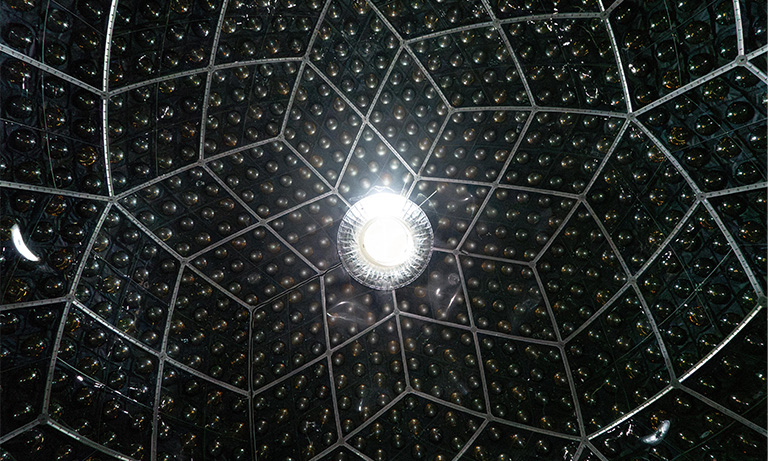
RICH検出器は、長さ約18 m、直径3.2〜3.8 mの円筒容器で構成され、その中央をビームパイプが貫通しています。容器内部には1 atmのネオンガスが充填されています。下流側には六角形ミラーのモザイクが設置されており、チェレンコフ光を集光して、上流側に配置された1000 × 2個の光検出器へと導きます。
反射されたチェレンコフ光は、約2000本の光電子増倍管 (PMT)、浜松ホトニクス製 R7400U-03によって集光されます。これらのデバイスは、そのコンパクトさと高速応答性から選定されました。
NA62のRICH検出器は、パイオンが通過する時間を約100 psの分解能で測定することができ、荷電トラックのL0トリガー生成にも使用されます。
LHCb実験は、重フレーバー・ハドロン生成の研究を目的としています。この実験では、ユニタリティ・トライアングルに関連するCKMパラメータを高精度で測定するとともに、標準模型を超える新しい物理の探索も行われます。
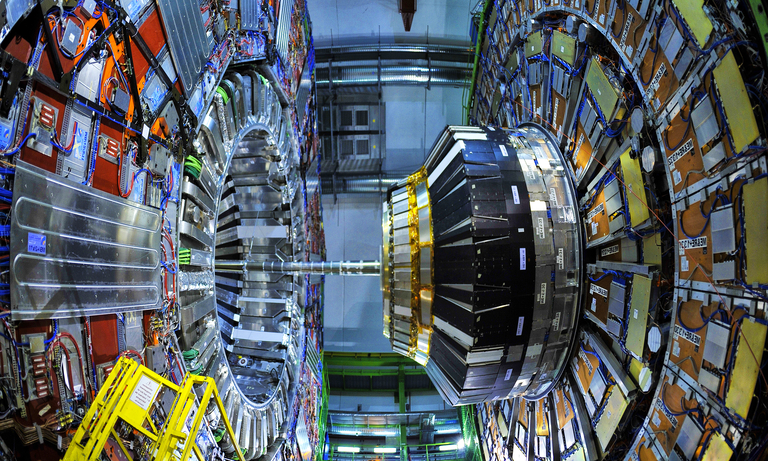
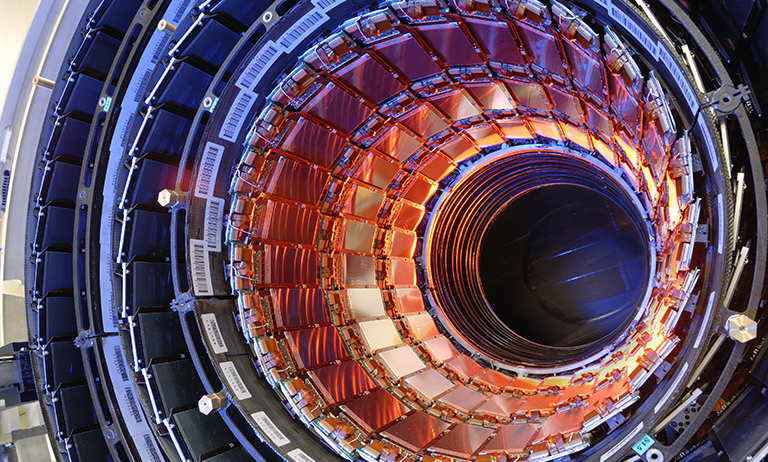
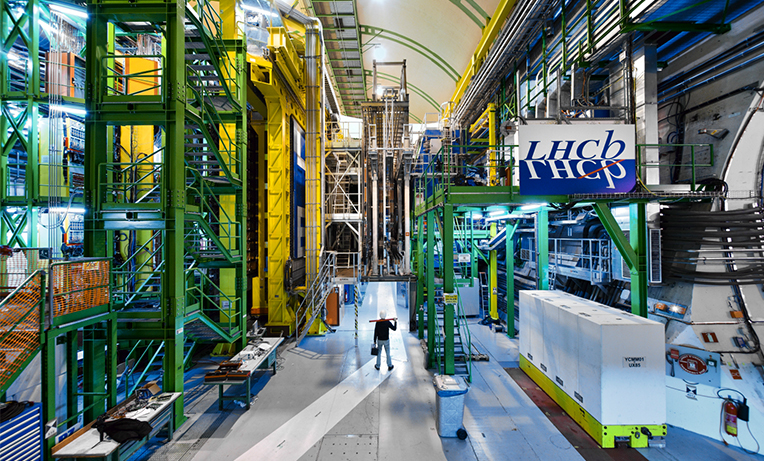
LHCbには、RICH型検出器として RICH1とRICH2の2基が搭載されています。
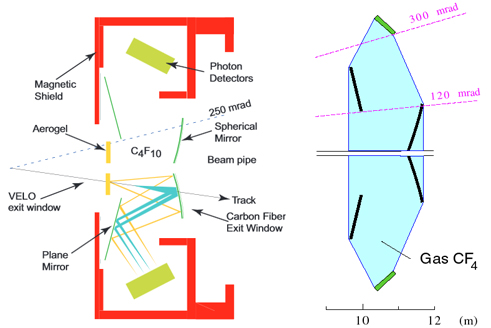
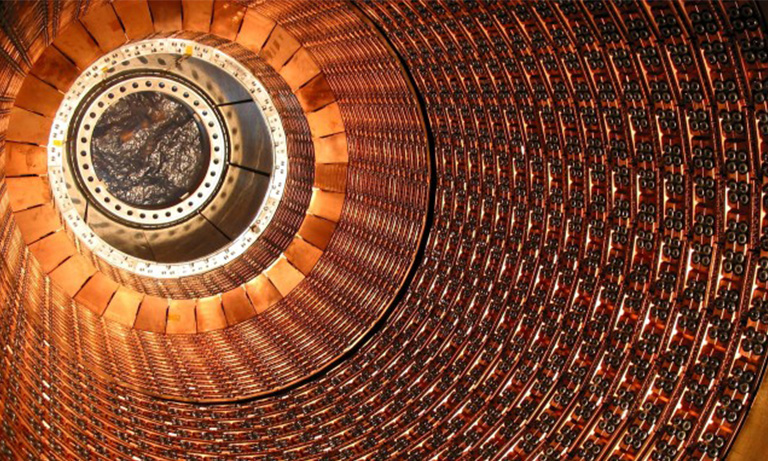
図2 LHCbのRICH検出器:左がRICH1、右がRICH2。
(© CERN)
RICH1は上流側に配置された検出器で、シリカエアロゲルおよびC₄F₁₀ガスをラジエーターとして使用しています (図2)。この検出器は低運動量粒子の検出に適しています。一方、RICH2は下流側に設置されており、ラジエーターとしてCF₄ガスを使用しています。RICH2の受容範囲は低角度領域に限定されており、この領域では主に高運動量粒子が観測されます。
初期のバージョンでは、RICH1とRICH2の両方でHPD (Hybrid PhotoDetector)が使用されていましたが、アップグレードの際にLHCbコラボレーションは、新たに浜松ホトニクス製のMAPMT (Multi-Anode Photomultiplier Tube、8×8 ピクセル)を採用し、ラジエーターで放出されるチェレンコフ光を収集する方式に移行しました。
RICH1とRICH2の内側領域には、アクティブエリア 23 × 23 mm²を持つ浜松ホトニクス製 R13742 (合計2700台)が選定されています。
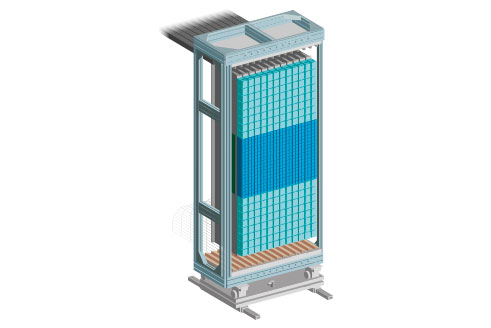
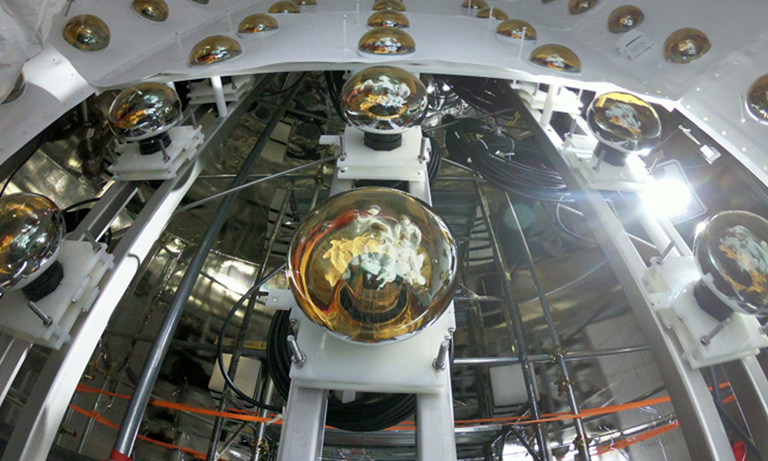
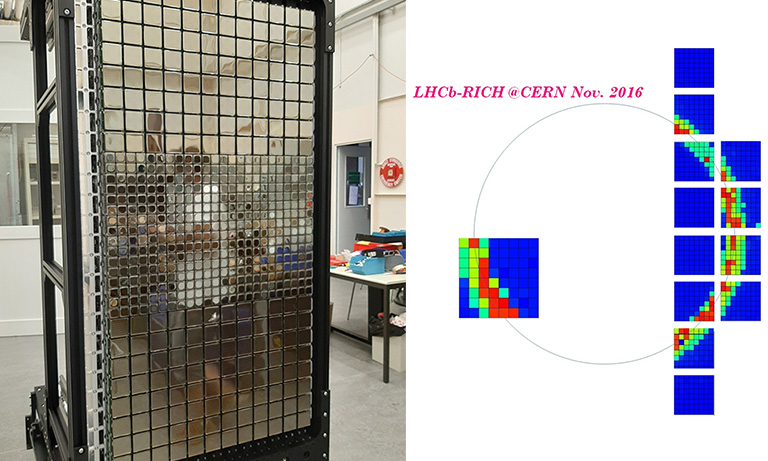
図3 RICH2検出器の感光面
RICH2の外側領域には、アクティブエリア 48.5 × 48.5 mm²のR13743 (400台のMAPMT)が選定されています (図3)。
現在、PMT系検出器 (光電子増倍管および多陽極光電子増倍管)を採用している理由は、暗電流が非常に小さいという利点があるためです。一方で、PMT系の検出器は粒子加速器環境に存在する強磁場に対して非常に敏感であるという弱点があります。
浜松ホトニクスは、PMTに代わる可能性のある技術を模索するため、いくつかのR&Dプロジェクトを進めています。研究により、シリコンフォトマル (SiPM)がRICHカウンターにおいて単一光子検出器として使用できることが示されています。SiPMの大きな利点は、磁場の影響を受けないことですが、一方で暗電流が高いという欠点があります。
近年、浜松ホトニクスは暗電流が比較的低く、アクティブエリアが大きいSiPM (MPPC:Multi-Pixel Photon Counter)を市販化しており、これにより信号対雑音比 (S/N 比)の大幅な改善が期待できます。これまでに、浜松ホトニクス製8 × 8 チャンネル S11834 MPPCモジュールが試験ビームで評価され、良好な結果が得られています。
- Confirmation
-
It looks like you're in the . If this is not your location, please select the correct region or country below.
You're headed to Hamamatsu Photonics website for JP (Japanese). If you want to view an other country's site, the optimized information will be provided by selecting options below.
In order to use this website comfortably, we use cookies. For cookie details please see our cookie policy.
- Cookie Policy
-
This website or its third-party tools use cookies, which are necessary to its functioning and required to achieve the purposes illustrated in this cookie policy. By closing the cookie warning banner, scrolling the page, clicking a link or continuing to browse otherwise, you agree to the use of cookies.
Hamamatsu uses cookies in order to enhance your experience on our website and ensure that our website functions.
You can visit this page at any time to learn more about cookies, get the most up to date information on how we use cookies and manage your cookie settings. We will not use cookies for any purpose other than the ones stated, but please note that we reserve the right to update our cookies.
1. What are cookies?
For modern websites to work according to visitor’s expectations, they need to collect certain basic information about visitors. To do this, a site will create small text files which are placed on visitor’s devices (computer or mobile) - these files are known as cookies when you access a website. Cookies are used in order to make websites function and work efficiently. Cookies are uniquely assigned to each visitor and can only be read by a web server in the domain that issued the cookie to the visitor. Cookies cannot be used to run programs or deliver viruses to a visitor’s device.
Cookies do various jobs which make the visitor’s experience of the internet much smoother and more interactive. For instance, cookies are used to remember the visitor’s preferences on sites they visit often, to remember language preference and to help navigate between pages more efficiently. Much, though not all, of the data collected is anonymous, though some of it is designed to detect browsing patterns and approximate geographical location to improve the visitor experience.
Certain type of cookies may require the data subject’s consent before storing them on the computer.
2. What are the different types of cookies?
This website uses two types of cookies:
- First party cookies. For our website, the first party cookies are controlled and maintained by Hamamatsu. No other parties have access to these cookies.
- Third party cookies. These cookies are implemented by organizations outside Hamamatsu. We do not have access to the data in these cookies, but we use these cookies to improve the overall website experience.
3. How do we use cookies?
This website uses cookies for following purposes:
- Certain cookies are necessary for our website to function. These are strictly necessary cookies and are required to enable website access, support navigation or provide relevant content. These cookies direct you to the correct region or country, and support security and ecommerce. Strictly necessary cookies also enforce your privacy preferences. Without these strictly necessary cookies, much of our website will not function.
- Analytics cookies are used to track website usage. This data enables us to improve our website usability, performance and website administration. In our analytics cookies, we do not store any personal identifying information.
- Functionality cookies. These are used to recognize you when you return to our website. This enables us to personalize our content for you, greet you by name and remember your preferences (for example, your choice of language or region).
- These cookies record your visit to our website, the pages you have visited and the links you have followed. We will use this information to make our website and the advertising displayed on it more relevant to your interests. We may also share this information with third parties for this purpose.
Cookies help us help you. Through the use of cookies, we learn what is important to our visitors and we develop and enhance website content and functionality to support your experience. Much of our website can be accessed if cookies are disabled, however certain website functions may not work. And, we believe your current and future visits will be enhanced if cookies are enabled.
4. Which cookies do we use?
There are two ways to manage cookie preferences.
- You can set your cookie preferences on your device or in your browser.
- You can set your cookie preferences at the website level.
If you don’t want to receive cookies, you can modify your browser so that it notifies you when cookies are sent to it or you can refuse cookies altogether. You can also delete cookies that have already been set.
If you wish to restrict or block web browser cookies which are set on your device then you can do this through your browser settings; the Help function within your browser should tell you how. Alternatively, you may wish to visit www.aboutcookies.org, which contains comprehensive information on how to do this on a wide variety of desktop browsers.
5. What are Internet tags and how do we use them with cookies?
Occasionally, we may use internet tags (also known as action tags, single-pixel GIFs, clear GIFs, invisible GIFs and 1-by-1 GIFs) at this site and may deploy these tags/cookies through a third-party advertising partner or a web analytical service partner which may be located and store the respective information (including your IP-address) in a foreign country. These tags/cookies are placed on both online advertisements that bring users to this site and on different pages of this site. We use this technology to measure the visitors' responses to our sites and the effectiveness of our advertising campaigns (including how many times a page is opened and which information is consulted) as well as to evaluate your use of this website. The third-party partner or the web analytical service partner may be able to collect data about visitors to our and other sites because of these internet tags/cookies, may compose reports regarding the website’s activity for us and may provide further services which are related to the use of the website and the internet. They may provide such information to other parties if there is a legal requirement that they do so, or if they hire the other parties to process information on their behalf.
If you would like more information about web tags and cookies associated with on-line advertising or to opt-out of third-party collection of this information, please visit the Network Advertising Initiative website http://www.networkadvertising.org.
6. Analytics and Advertisement Cookies
We use third-party cookies (such as Google Analytics) to track visitors on our website, to get reports about how visitors use the website and to inform, optimize and serve ads based on someone's past visits to our website.
You may opt-out of Google Analytics cookies by the websites provided by Google:
https://tools.google.com/dlpage/gaoptout?hl=en
As provided in this Privacy Policy (Article 5), you can learn more about opt-out cookies by the website provided by Network Advertising Initiative:
http://www.networkadvertising.org
We inform you that in such case you will not be able to wholly use all functions of our website.
Close