





ビーム診断と実験
粒子加速器施設は、素粒子物理学の研究だけでなく医療応用のためにも、世界各地に広く設置されています。
ビーム診断装置は、加速器の適切な運転に欠かせない重要なツールです。これらの装置によりビームの特性を把握し、加速器内部で波動がどのように振る舞うのかを理解することができます。ビーム診断の分野は極めて広く、多様な物理現象が利用され、創意工夫が求められる領域でもあります。現在では、さまざまな手法を採用した多数の診断装置が利用可能です。加速器で監視すべき主要なビームパラメータには、通常、強度、位置、サイズと形状、エミッタンス、エネルギー、そして偏極 (ポラリゼーション)が含まれます。これらの測定はすべてビームに影響を与えますが、影響が無視できるものもあれば、ビームを破壊する測定もあります。
一般に「加速器は、その診断装置の性能を超えることはできない」と言われており、正確な計測機器こそがその基盤となっています。
粒子加速器は、高強度ビームまたは低強度ビームのいずれでも運転することができます。高強度の場合、残留ガスとの相互作用や蛍光モニターによってビームが発する可視光を直接測定することが可能です。
ビームパイプ内部におけるビーム重心位置の測定は、加速器運転において最も重要な項目のひとつです。そのため、可能な限りオンラインかつ非侵襲の測定系が求められます。ビームがDCモードで運転されている場合、sCMOSカメラを用いることでビーム重心の位置を定量的に測定できます。
この方式では、ビームがビームパイプ内の残留ガス原子を励起し、そこから光が放出されます。sCMOSカメラはこの光を検出し、その位置からビームの位置を推定できます。浜松ホトニクスは、この用途に特化した各種sCMOSカメラを製造しています。
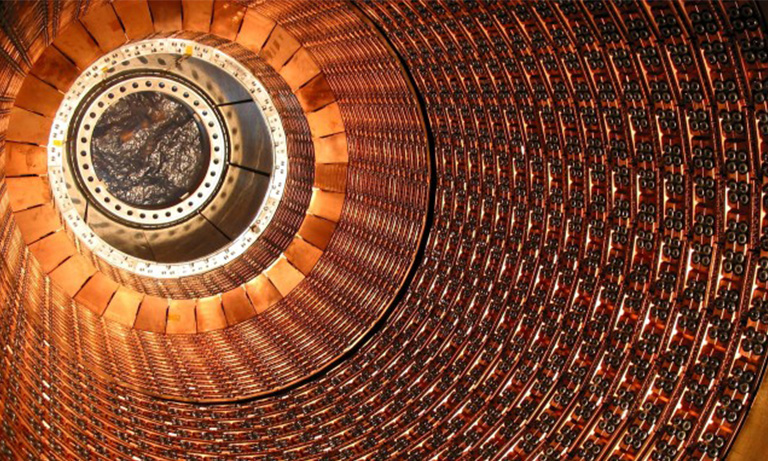
Cornell Electron-positron Storage Ring (CESR)は、コーネル大学キャンパスの駐車場の地下12 mに設置された、周長768 mの電子・陽電子衝突型加速器です。電子とその反粒子である陽電子を9〜12 GeVの重心系エネルギーで衝突させることができ、電子と陽電子が衝突・消滅する際に発生するエネルギーの閃光によって新たな物質が生成されます。生成される物質には、時に“奇妙”または“エキゾチック”な粒子も含まれ、CLEO実験の主な研究対象となっています。
ビーム診断の主要な目的のひとつは、単一バンチの縦方向および垂直方向のビームダイナミクスを測定し、ルミノシティの最適化に役立てることです。縦方向ビーム診断では、電子および陽電子が放出するシンクロトロン光を鏡で反射し、ストリークカメラへ導きます。浜松ホトニクス製C16910 ストリークカメラは、電子バンチ長を800 fsの時間分解能で測定することができます。
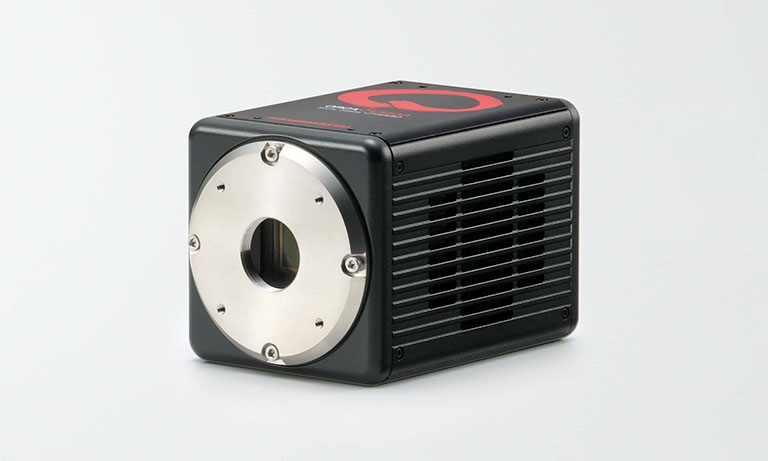
sCMOSカメラ

ストリークカメラ
電子・陽電子の垂直方向ビームサイズを測定するために、2基のPMTアレイが設置されています。各アレイには32チャンネルのリニアアノードが搭載されており、各チャンネルの有効受光面積は 0.8×7 mmです。PMT信号はサブナノ秒の立ち上がり時間を持ち、CESRにおけるすべてのバンチについて、個々の垂直ビームサイズを測定することができます。
ビームプロファイル測定では、残留ガスの電離によるプロファイル測定が利用されます。ビームと背景となる残留ガスが相互作用すると、電子・イオン対が生成され、これらはマイクロチャネルプレート (MCP)で収集され、その後に続く1平面の位置敏感検出器によって検出されます。ビーム重心位置の測定と同様に、MCPが収集・増幅した電荷の測定値から、一次ビームのプロファイルが再構成されます。
ビームプロファイルを解析するもう1つの手法は、一次陽子と残留ガスとの相互作用によって生じる蛍光を測定するものです。この可視光はsCMOSカメラで検出することが可能で、ビームサイズに関する定性的な情報が得られます。この技術を用いる加速器では、ビームモニターが観測する位置に特殊ガラス製ウィンドウが設置されます。NIRS-HIMACは、日本・千葉にある医療用の重イオンシンクロトロン複合施設です。ミリメートル精度で腫瘍を照射したり、診断・治療用の大量の放射性アイソトープを生成したりするため、ビームの位置・強度・形状を精密に制御することが不可欠です。
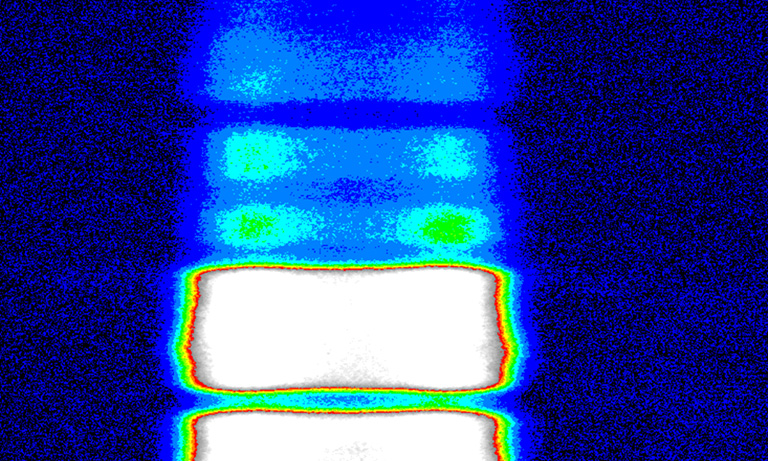
この施設のビームプロファイルモニタリングシステムは、図に示すように、2段階MCP、イメージインテンシファイア、sCMOSカメラによって構成されています。
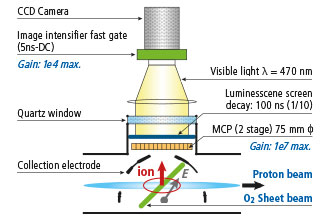
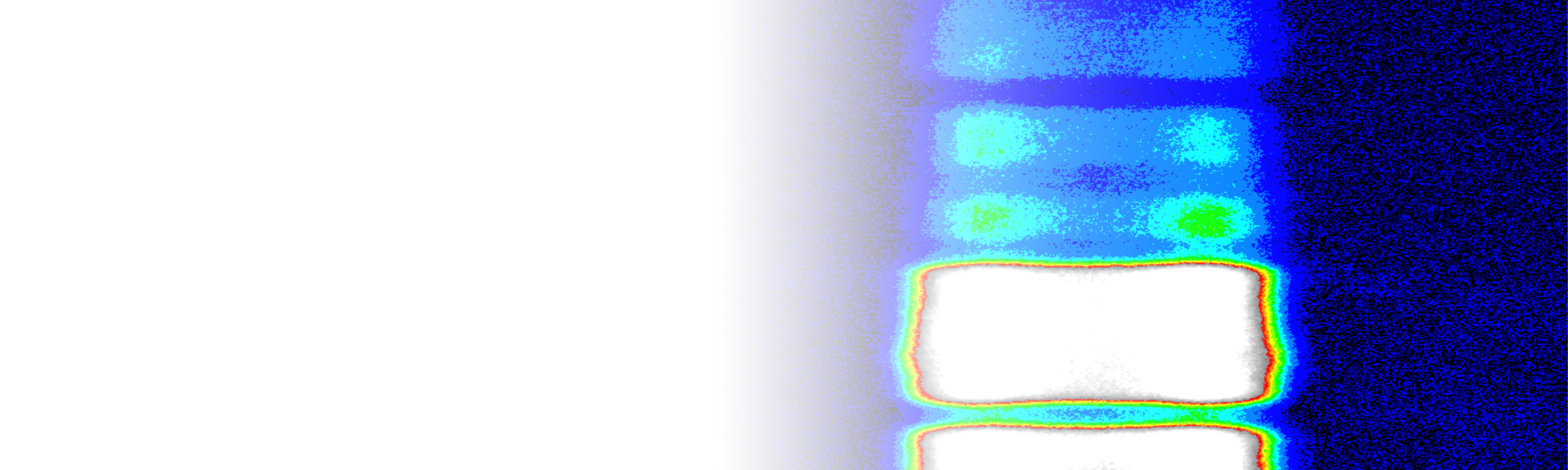
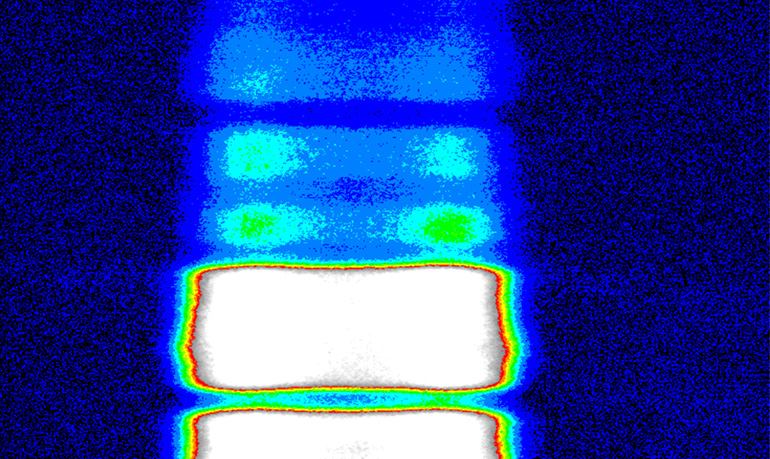
ビームによって傾斜シート型ビームターゲット上に生成されたイオンは、放射状電場によって収集されます。この電場は半球状電極によって形成され、2段階MCP (浜松ホトニクス F2226、最大ゲイン 1×10⁷)によって増幅されます。蛍光面 (光の減衰時間:1/10 にて 100 ns)からの発光は、イメージインテンシファイア (I.I.:最大ゲイン 1×10⁴、浜松ホトニクス C9546-04)を介して接続されたsCMOSカメラによって検出されます。図には、NIRSサイクロトロンにおける 8 MeV・5 µAのビームプロファイル画像が示されています。
粒子加速器が低強度で運転される場合、特にがん治療に使用される放射性イオンビームでは、求められるビーム診断装置の特性が大きく異なります。このような状況では、診断システムはビーム調整を繰り返し行う必要があるため、非常に堅牢で低コストであることが要求されます。これは、長時間の連続稼働、人為的な操作ミスによる過剰被曝、そして通常運転に伴うあらゆる条件に耐える必要があるためです。
このため、通常採用される解決策はシンチレーション検出器です。これはシンチレーター材料 (一般的には NaI)と光センサーを光学的に結合した構造を持ちます。シンチレーターはビームを受け止め、堆積エネルギー100 eVあたり平均1光子を発生させます。光の読み取り装置は目的に応じて異なる種類が使用されます。
フォトダイオードは電流読み出しに適しており、光電子増倍管 (PMT)やアバランシェフォトダイオード (APD)はパルス計数に適しています。また、単一光子計数用に特別に校正されたPMTも存在します。
- Confirmation
-
It looks like you're in the . If this is not your location, please select the correct region or country below.
You're headed to Hamamatsu Photonics website for JP (Japanese). If you want to view an other country's site, the optimized information will be provided by selecting options below.
In order to use this website comfortably, we use cookies. For cookie details please see our cookie policy.
- Cookie Policy
-
This website or its third-party tools use cookies, which are necessary to its functioning and required to achieve the purposes illustrated in this cookie policy. By closing the cookie warning banner, scrolling the page, clicking a link or continuing to browse otherwise, you agree to the use of cookies.
Hamamatsu uses cookies in order to enhance your experience on our website and ensure that our website functions.
You can visit this page at any time to learn more about cookies, get the most up to date information on how we use cookies and manage your cookie settings. We will not use cookies for any purpose other than the ones stated, but please note that we reserve the right to update our cookies.
1. What are cookies?
For modern websites to work according to visitor’s expectations, they need to collect certain basic information about visitors. To do this, a site will create small text files which are placed on visitor’s devices (computer or mobile) - these files are known as cookies when you access a website. Cookies are used in order to make websites function and work efficiently. Cookies are uniquely assigned to each visitor and can only be read by a web server in the domain that issued the cookie to the visitor. Cookies cannot be used to run programs or deliver viruses to a visitor’s device.
Cookies do various jobs which make the visitor’s experience of the internet much smoother and more interactive. For instance, cookies are used to remember the visitor’s preferences on sites they visit often, to remember language preference and to help navigate between pages more efficiently. Much, though not all, of the data collected is anonymous, though some of it is designed to detect browsing patterns and approximate geographical location to improve the visitor experience.
Certain type of cookies may require the data subject’s consent before storing them on the computer.
2. What are the different types of cookies?
This website uses two types of cookies:
- First party cookies. For our website, the first party cookies are controlled and maintained by Hamamatsu. No other parties have access to these cookies.
- Third party cookies. These cookies are implemented by organizations outside Hamamatsu. We do not have access to the data in these cookies, but we use these cookies to improve the overall website experience.
3. How do we use cookies?
This website uses cookies for following purposes:
- Certain cookies are necessary for our website to function. These are strictly necessary cookies and are required to enable website access, support navigation or provide relevant content. These cookies direct you to the correct region or country, and support security and ecommerce. Strictly necessary cookies also enforce your privacy preferences. Without these strictly necessary cookies, much of our website will not function.
- Analytics cookies are used to track website usage. This data enables us to improve our website usability, performance and website administration. In our analytics cookies, we do not store any personal identifying information.
- Functionality cookies. These are used to recognize you when you return to our website. This enables us to personalize our content for you, greet you by name and remember your preferences (for example, your choice of language or region).
- These cookies record your visit to our website, the pages you have visited and the links you have followed. We will use this information to make our website and the advertising displayed on it more relevant to your interests. We may also share this information with third parties for this purpose.
Cookies help us help you. Through the use of cookies, we learn what is important to our visitors and we develop and enhance website content and functionality to support your experience. Much of our website can be accessed if cookies are disabled, however certain website functions may not work. And, we believe your current and future visits will be enhanced if cookies are enabled.
4. Which cookies do we use?
There are two ways to manage cookie preferences.
- You can set your cookie preferences on your device or in your browser.
- You can set your cookie preferences at the website level.
If you don’t want to receive cookies, you can modify your browser so that it notifies you when cookies are sent to it or you can refuse cookies altogether. You can also delete cookies that have already been set.
If you wish to restrict or block web browser cookies which are set on your device then you can do this through your browser settings; the Help function within your browser should tell you how. Alternatively, you may wish to visit www.aboutcookies.org, which contains comprehensive information on how to do this on a wide variety of desktop browsers.
5. What are Internet tags and how do we use them with cookies?
Occasionally, we may use internet tags (also known as action tags, single-pixel GIFs, clear GIFs, invisible GIFs and 1-by-1 GIFs) at this site and may deploy these tags/cookies through a third-party advertising partner or a web analytical service partner which may be located and store the respective information (including your IP-address) in a foreign country. These tags/cookies are placed on both online advertisements that bring users to this site and on different pages of this site. We use this technology to measure the visitors' responses to our sites and the effectiveness of our advertising campaigns (including how many times a page is opened and which information is consulted) as well as to evaluate your use of this website. The third-party partner or the web analytical service partner may be able to collect data about visitors to our and other sites because of these internet tags/cookies, may compose reports regarding the website’s activity for us and may provide further services which are related to the use of the website and the internet. They may provide such information to other parties if there is a legal requirement that they do so, or if they hire the other parties to process information on their behalf.
If you would like more information about web tags and cookies associated with on-line advertising or to opt-out of third-party collection of this information, please visit the Network Advertising Initiative website http://www.networkadvertising.org.
6. Analytics and Advertisement Cookies
We use third-party cookies (such as Google Analytics) to track visitors on our website, to get reports about how visitors use the website and to inform, optimize and serve ads based on someone's past visits to our website.
You may opt-out of Google Analytics cookies by the websites provided by Google:
https://tools.google.com/dlpage/gaoptout?hl=en
As provided in this Privacy Policy (Article 5), you can learn more about opt-out cookies by the website provided by Network Advertising Initiative:
http://www.networkadvertising.org
We inform you that in such case you will not be able to wholly use all functions of our website.
Close