




深地下・深海観測用検出器
数キロメートルの岩盤や氷の下、あるいは深海の深淵に設置された粒子物理実験施設は、宇宙をこれまでとは異なる独自の視点から観測することを可能にし、挑戦的で画期的な発見をもたらす可能性を秘めています。
厚い岩盤や氷の層は、宇宙から到来する多くの粒子を大幅に遮蔽するため、観測できるのは主にニュートリノのみとなります。ニュートリノは宇宙に非常に豊富に存在する素粒子ですが、物質とほとんど相互作用しないため、研究が極めて難しい粒子です。
ニュートリノは、ベータ崩壊の連続スペクトルを説明するため、1930年に Wolfgang Pauli 氏 によって初めて提唱されました。しかし、その存在が実際に確認されたのは 1956年で、Clyde Cowan氏 と Frederick Reines氏 が、サウスカロライナ州サバンナ・リバー原子炉をベータ崩壊源として用いる革新的な実験を実施した際のことでした。
ニュートリノは、地球に到達するまでに軌道が曲げられず、ほぼまっすぐ進んでくるという特性から、遠方にある強力な放射源 (クエーサーやガンマ線バーストなど)を特定するための独自の観測手段となります。また、超新星爆発や重力波のような宇宙の破局的現象の解明にも貢献することが期待されています。
ニュートリノは物質との相互作用が非常に弱く、かつ電荷を持たないため、巨大な検出器を用い、検出器内部でニュートリノとの相互作用によって生成された二次荷電粒子が放出するチェレンコフ光を観測することで検出されます。荷電粒子が媒質中をその媒質における光の位相速度を超える速度で通過すると、チェレンコフ光が放出されます。
日本のスーパーカミオカンデ、南極のIceCube、地中海に建設が進むKM3NeTなどは、現在および将来の実験の代表的な例であり、アストロ粒子物理学に大きく貢献することが期待されています。
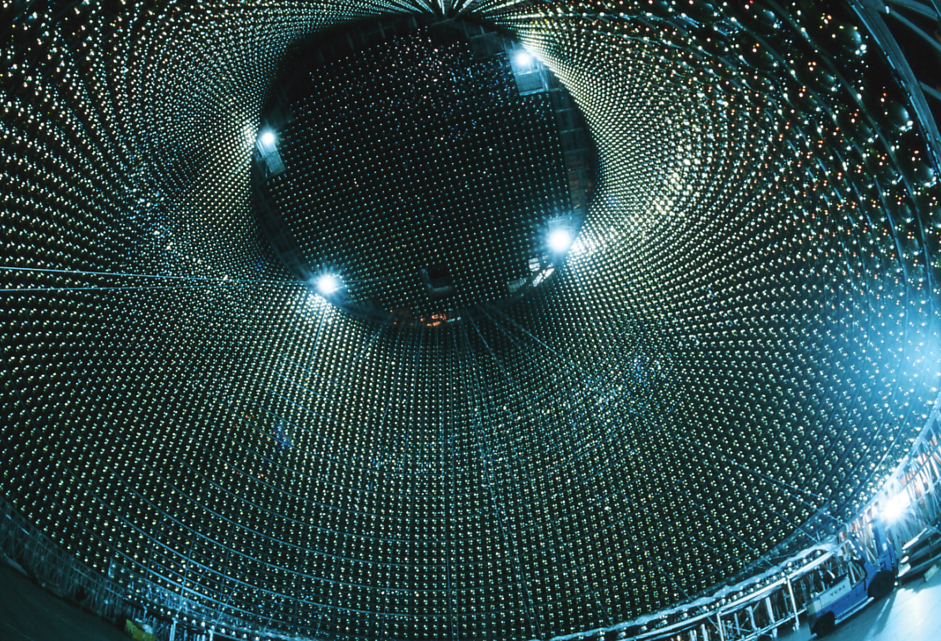
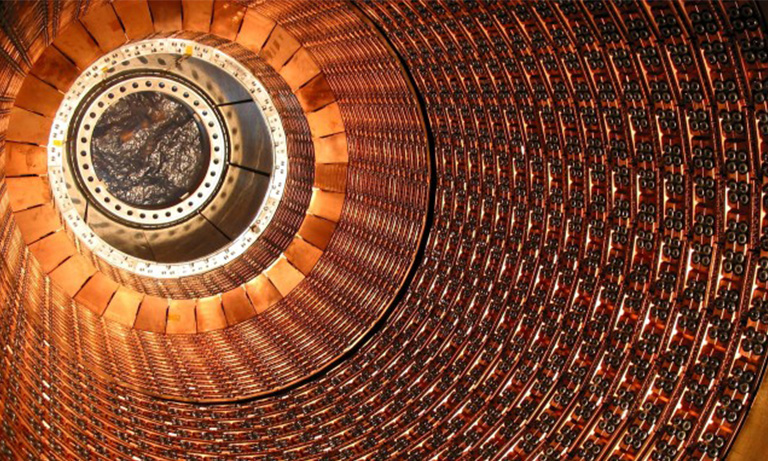
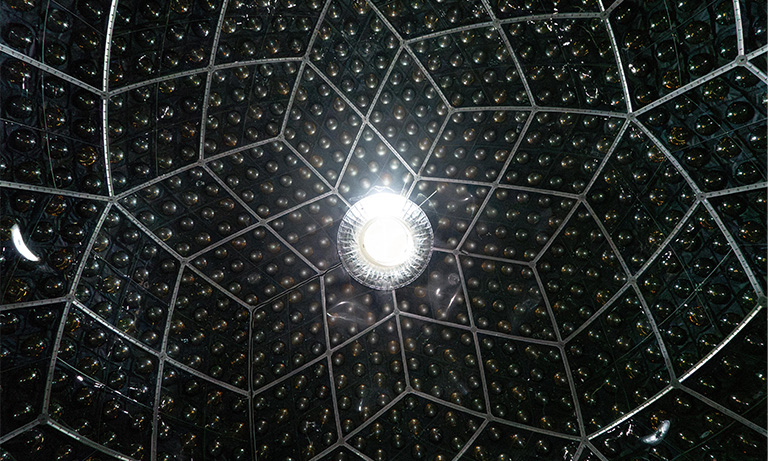
スーパーカミオカンデ内槽の様子
スーパーカミオカンデは、東京大学宇宙線研究所・神岡観測所にある、池ノ山の地下1000 mに設置されたニュートリノ観測装置です。
この装置は、ニュートリノ振動の研究および核子崩壊の探索を目的として設計され、1996年に運用を開始しました。長年にわたり、大気ニュートリノおよび太陽ニュートリノの振動に関する重要な成果を上げるとともに、核子崩壊、ダークマターの存在、ニュートリノの天体起源に対する厳しい制限を与えてきました。
スーパーカミオカンデは、世界で初めてニュートリノが質量を持ち、フレーバー振動を起こすことを決定的に示しました。この成果により、2015年には スーパーカミオカンデ実験の梶田隆章氏が、カナダのニュートリノ振動実験SNO (Sudbury Neutrino Observatory)の Arthur B. McDonald 氏とともに、ノーベル物理学賞を受賞しました。
検出器は高さ41.4 m、直径39.3 mの円筒形で、内部には50 ktonの超純水が満たされています。装置は内槽 (Inner Detector)と外槽 (Outer Detector)に分かれており、外槽は外部からのバックグラウンドを排除するためのビート検出器として機能します。内槽には直径50 cmの浜松ホトニクス製PMT (R3600)が1万1129本設置され、外槽には直径20 cmのPMT (R5912)が1885本設置されています。
ニュートリノが水中の電子や原子核と相互作用すると、荷電粒子が生成され、この粒子が進む方向にチェレンコフ光の円錐が形成されます。光の円錐は検出器の壁にリングとして投影され、光電子増倍管によって記録されます。
この検出器のアップグレード版であるハイパーカミオカンデは、国際共同研究として進められており、スーパーカミオカンデの約10倍の規模を持ちます。
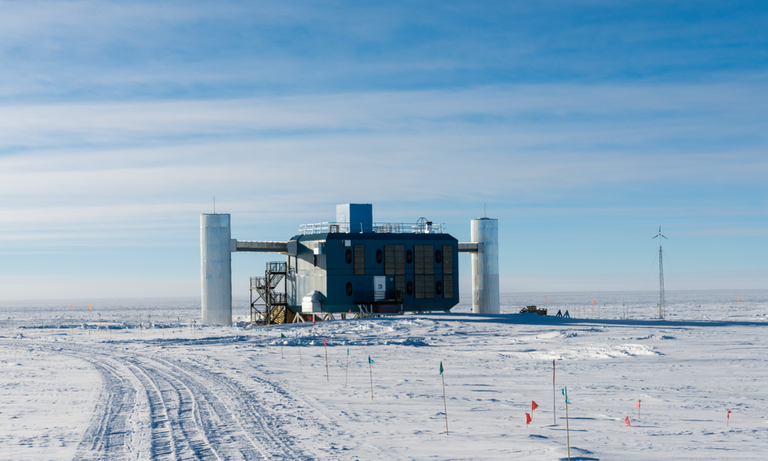
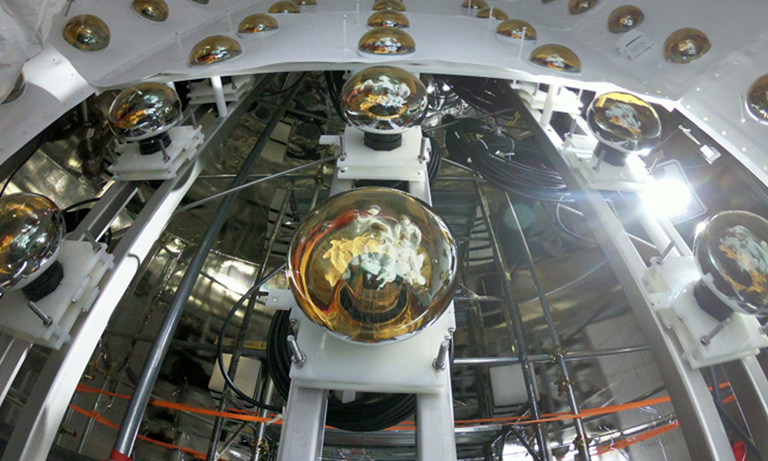
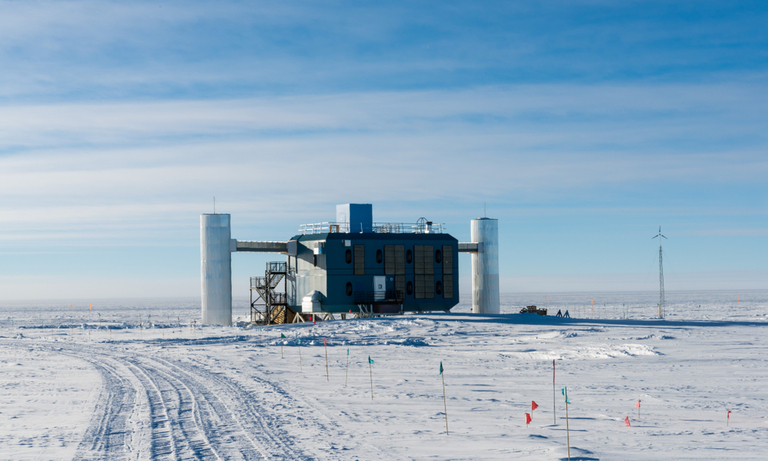
アイスキューブ・ニュートリノ観測所は、南極点のアムンセン=スコット基地に建設されたニュートリノ望遠鏡です。観測装置は、Digital Optical Module (DOM)と呼ばれる球状光学センサー 5160基から構成され、それぞれに直径10インチの浜松ホトニクス製PMT (R7081-02)が搭載されています。
DOMは86本の垂直ケーブルに沿って配置され、各ケーブルには60基のDOMが取り付けられています。これらは透明度の高い氷の中、深さ1450〜2450 mの範囲に設置されており、1立方キロメートルの氷を観測体積としています。
DOMは、高エネルギーニュートリノが地球を貫通した後に氷中で起こす相互作用によって生成される高速荷電粒子が放出する光を検出します。この南極の観測装置には、地表に設置されたIceTopと、検出可能エネルギーを100 GeV以下に拡張するDeepCoreも含まれています。IceTopは宇宙線の組成研究や、氷中でニュートリノ事象と誤認され得る宇宙線由来のミューオンの識別に利用されます。DeepCoreのストリングは、大規模配列の中心部、深さ1760〜2450 mに設置されています。
2013年11月、IceCubeコラボレーションは、30〜1200 TeVのエネルギーを持つニュートリノ 28事象を検出したと発表しました。これらは太陽系外に由来すると考えられ、予想されるバックグラウンドを大きく上回るものでした。
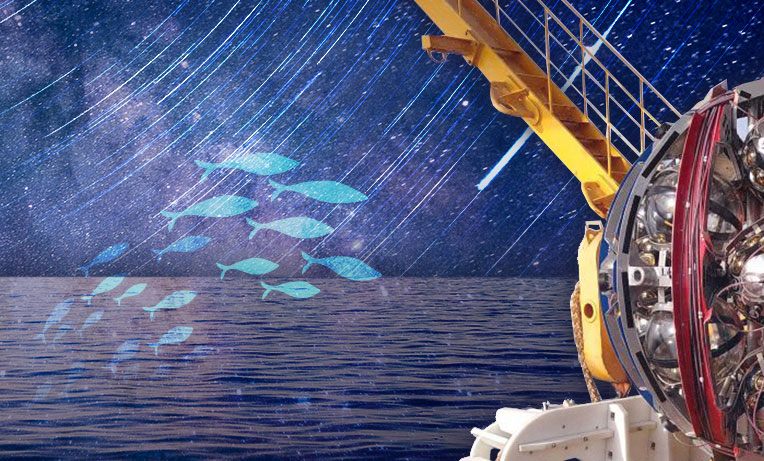
KM3NeTは、その名が示す通り「数立方キロメートル規模」の観測体積を持つ将来の実験で、地中海の深海に2地点、フランス・トゥーロン沖のORCAと、イタリア・Portopalo di Capo Passero 沖のARCAに建設される予定です。
主な目的は、超新星残骸、ガンマ線バースト、恒星衝突など、遠方の破局的天体現象からのニュートリノを検出することにあります。また、宇宙におけるダークマターの探索にも貢献します。
IceCubeと同様、KM3NeTはDOMを垂直ケーブルに沿って配置し、海中でニュートリノ相互作用によって生成されたミューオンが放出するチェレンコフ光を検出します。各DOMは独立したモジュールで、17インチのガラス球内部に、直径3インチの浜松ホトニクス製PMT (R12199-02/R14374-02)が31本組み込まれています。
また、この実験施設には地球科学および海洋科学のための観測装置も搭載され、数キロメートル深の海洋環境のオンラインモニタリングも行われます。
- Confirmation
-
It looks like you're in the . If this is not your location, please select the correct region or country below.
You're headed to Hamamatsu Photonics website for JP (Japanese). If you want to view an other country's site, the optimized information will be provided by selecting options below.
In order to use this website comfortably, we use cookies. For cookie details please see our cookie policy.
- Cookie Policy
-
This website or its third-party tools use cookies, which are necessary to its functioning and required to achieve the purposes illustrated in this cookie policy. By closing the cookie warning banner, scrolling the page, clicking a link or continuing to browse otherwise, you agree to the use of cookies.
Hamamatsu uses cookies in order to enhance your experience on our website and ensure that our website functions.
You can visit this page at any time to learn more about cookies, get the most up to date information on how we use cookies and manage your cookie settings. We will not use cookies for any purpose other than the ones stated, but please note that we reserve the right to update our cookies.
1. What are cookies?
For modern websites to work according to visitor’s expectations, they need to collect certain basic information about visitors. To do this, a site will create small text files which are placed on visitor’s devices (computer or mobile) - these files are known as cookies when you access a website. Cookies are used in order to make websites function and work efficiently. Cookies are uniquely assigned to each visitor and can only be read by a web server in the domain that issued the cookie to the visitor. Cookies cannot be used to run programs or deliver viruses to a visitor’s device.
Cookies do various jobs which make the visitor’s experience of the internet much smoother and more interactive. For instance, cookies are used to remember the visitor’s preferences on sites they visit often, to remember language preference and to help navigate between pages more efficiently. Much, though not all, of the data collected is anonymous, though some of it is designed to detect browsing patterns and approximate geographical location to improve the visitor experience.
Certain type of cookies may require the data subject’s consent before storing them on the computer.
2. What are the different types of cookies?
This website uses two types of cookies:
- First party cookies. For our website, the first party cookies are controlled and maintained by Hamamatsu. No other parties have access to these cookies.
- Third party cookies. These cookies are implemented by organizations outside Hamamatsu. We do not have access to the data in these cookies, but we use these cookies to improve the overall website experience.
3. How do we use cookies?
This website uses cookies for following purposes:
- Certain cookies are necessary for our website to function. These are strictly necessary cookies and are required to enable website access, support navigation or provide relevant content. These cookies direct you to the correct region or country, and support security and ecommerce. Strictly necessary cookies also enforce your privacy preferences. Without these strictly necessary cookies, much of our website will not function.
- Analytics cookies are used to track website usage. This data enables us to improve our website usability, performance and website administration. In our analytics cookies, we do not store any personal identifying information.
- Functionality cookies. These are used to recognize you when you return to our website. This enables us to personalize our content for you, greet you by name and remember your preferences (for example, your choice of language or region).
- These cookies record your visit to our website, the pages you have visited and the links you have followed. We will use this information to make our website and the advertising displayed on it more relevant to your interests. We may also share this information with third parties for this purpose.
Cookies help us help you. Through the use of cookies, we learn what is important to our visitors and we develop and enhance website content and functionality to support your experience. Much of our website can be accessed if cookies are disabled, however certain website functions may not work. And, we believe your current and future visits will be enhanced if cookies are enabled.
4. Which cookies do we use?
There are two ways to manage cookie preferences.
- You can set your cookie preferences on your device or in your browser.
- You can set your cookie preferences at the website level.
If you don’t want to receive cookies, you can modify your browser so that it notifies you when cookies are sent to it or you can refuse cookies altogether. You can also delete cookies that have already been set.
If you wish to restrict or block web browser cookies which are set on your device then you can do this through your browser settings; the Help function within your browser should tell you how. Alternatively, you may wish to visit www.aboutcookies.org, which contains comprehensive information on how to do this on a wide variety of desktop browsers.
5. What are Internet tags and how do we use them with cookies?
Occasionally, we may use internet tags (also known as action tags, single-pixel GIFs, clear GIFs, invisible GIFs and 1-by-1 GIFs) at this site and may deploy these tags/cookies through a third-party advertising partner or a web analytical service partner which may be located and store the respective information (including your IP-address) in a foreign country. These tags/cookies are placed on both online advertisements that bring users to this site and on different pages of this site. We use this technology to measure the visitors' responses to our sites and the effectiveness of our advertising campaigns (including how many times a page is opened and which information is consulted) as well as to evaluate your use of this website. The third-party partner or the web analytical service partner may be able to collect data about visitors to our and other sites because of these internet tags/cookies, may compose reports regarding the website’s activity for us and may provide further services which are related to the use of the website and the internet. They may provide such information to other parties if there is a legal requirement that they do so, or if they hire the other parties to process information on their behalf.
If you would like more information about web tags and cookies associated with on-line advertising or to opt-out of third-party collection of this information, please visit the Network Advertising Initiative website http://www.networkadvertising.org.
6. Analytics and Advertisement Cookies
We use third-party cookies (such as Google Analytics) to track visitors on our website, to get reports about how visitors use the website and to inform, optimize and serve ads based on someone's past visits to our website.
You may opt-out of Google Analytics cookies by the websites provided by Google:
https://tools.google.com/dlpage/gaoptout?hl=en
As provided in this Privacy Policy (Article 5), you can learn more about opt-out cookies by the website provided by Network Advertising Initiative:
http://www.networkadvertising.org
We inform you that in such case you will not be able to wholly use all functions of our website.
Close